Loose Lead Walking
Written by Jess Kirby
IMDT-accredited dog trainer | BSc (Hons) Animal Behaviour & Training
Owner of Well Behaved Mutts, York
Jess runs Well Behaved Mutts in York, helping owners with practical, reward-based puppy and dog training.
Key Takeaways
Loose lead walking is not about forcing a dog to march perfectly beside you.
It is a skill that needs to be taught gradually.
Remember:
Dogs naturally move faster than we do, so walking at our pace can be difficult.
Pulling often continues because pulling has worked in the past.
Start training somewhere quiet and relatively easy.
Avoid beginning your hardest training at the most exciting part of the walk.
Practise when you are not in a rush or trying to reach somewhere.
Use rewards your dog genuinely values.
Reward beside your leg to create a useful reward zone.
Reinforce voluntary check-ins.
Change direction rather than getting into a tug of war.
If the lead becomes tight, stopping can help prevent pulling from being rewarded with forward movement.
Keep sessions short and achievable.
Allow your dog plenty of opportunities to sniff and enjoy their walk.
The goal is not perfection.
For me, successful loose lead walking means having a dog who can walk on a reasonably relaxed lead, stay connected with their owner and learn that being close and checking in is rewarding.
Loose Lead Walking
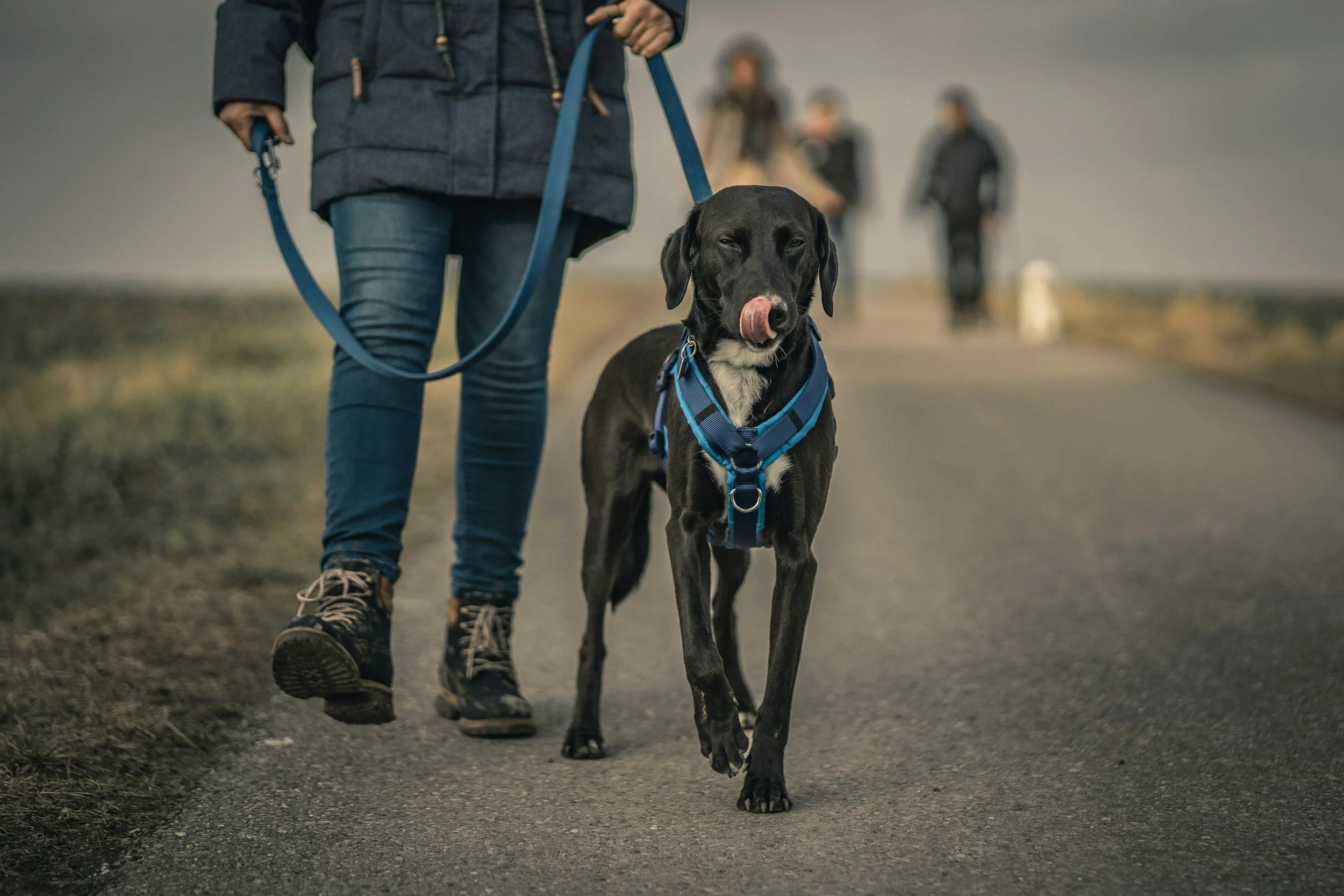
Loose lead walking is actually quite difficult for many dogs.
When we think about how dogs naturally move compared with us, it is easy to see why. Dogs are usually much quicker, they cover more ground with each stride, and they naturally want to stop and investigate smells along the way.
A dog may smell something several metres ahead and want to reach it immediately. Because they can move faster than we do, that is often when the lead becomes tight and pulling begins.
Dogs also were not originally bred to walk perfectly beside people on a lead.
Think about a spaniel, for example. Many spaniels were bred to search and cover large areas of ground, often moving from side to side as they worked. If your spaniel zig-zags in front of you on a walk, they are not necessarily trying to be difficult. A lot of that behaviour comes very naturally to them.
That is why it is important to remember that loose lead walking is a skill we need to teach. It does not automatically come naturally to a dog.
Why Do Dogs Pull on the Lead?
One of the biggest reasons dogs pull is very simple:
Pulling works.
If your dog pulls towards an interesting smell and eventually reaches it, what have they learnt?
They have learnt:
“If I pull hard enough, I get there.”
The same thing can happen when a dog wants to reach another dog, a person, a lamp post, a patch of grass or somewhere exciting.
From the dog's point of view, pulling can therefore be extremely rewarding.
Dogs repeat behaviours that work for them. If pulling regularly gets them closer to something they want, it makes sense that they will continue trying it.
Another factor is excitement.
Think about when your dog is normally most excited during a walk.
It is often when you first pick up the lead, open the front door, leave the house or arrive somewhere exciting.
Yet this is often the exact moment we expect the dog to walk calmly beside us.
That is a difficult ask, especially for a young dog or a dog that has not yet been taught what we want them to do.
Common Mistake: Pulling the Dog Back
One thing I often see is owners pulling the lead backwards whenever their dog pulls forwards.
The dog pulls forwards.
The owner pulls backwards.
The dog pulls harder.
The owner pulls harder.
Before long, both dog and owner are involved in a tug of war.
Many dogs will also lean into steady pressure on the lead, making the pulling feel even stronger.
Instead of repeatedly telling the dog where we do not want them to be, I would rather teach them where we do want them to walk.
Loose lead walking becomes much clearer when the dog learns that being close to us and keeping the lead relaxed is worthwhile.
Common Mistake: The Reward Is Not Valuable Enough
Another common issue is that the reward we are offering simply is not as exciting as the environment.
Imagine your dog has:
an amazing smell nearby;
another dog in front of them;
people walking past;
birds or squirrels moving around;
food on the floor;
somewhere exciting they want to reach.
Meanwhile, we are standing there with one piece of dry biscuit asking them to pay attention to us.
Sometimes the environment is simply more rewarding.
That does not mean your dog is stubborn or deliberately refusing to listen.
We may need to make the exercise easier or make our reward more worthwhile.
That could mean using higher-value food, rewarding more frequently, creating more distance from distractions or moving somewhere quieter where your dog can actually concentrate.
When practising loose lead walking, small treats that your dog can eat quickly are particularly useful because you may need to reward frequently at first.
You can also find a selection of dog treats in the Well Behaved Mutts online shop if you need training rewards to use at home.
[Visit the Well Behaved Mutts Shop]
Common Mistake: Allowing Pulling to Work Sometimes
Consistency can also be difficult.
Sometimes we are in a rush.
The dog starts pulling and we think:
“It doesn't matter this time. I just need to get there.”
The problem is that our dog does not understand that pulling only worked because we happened to be running late.
They simply learn that pulling sometimes gets them where they want to go.
You do not need every walk to become a formal training session, but when you are specifically practising loose lead walking, try to make sure the behaviour you want is the behaviour being reinforced.
Do Not Start With the Hardest Part of the Walk
One of my favourite loose lead walking tips is not to begin your main training session at the start of the walk.
That is often when excitement is at its highest.
Instead, give your dog some time first.
Let them sniff.
Let them explore.
Allow some of that initial excitement to settle.
Then practise your loose lead walking later in the walk or on the way home.
You may find your dog is calmer, less excited and much more capable of concentrating on you.
You could also take your dog for their usual walk or to a secure dog field and then practise for five minutes near home afterwards.
The important thing is that you are choosing a time when your dog is more capable of succeeding.
Practise When You Are Not Trying to Get Anywhere
Another thing I strongly recommend is practising loose lead walking when you do not actually need to reach a particular destination.
If you have ten minutes to get from home to the park, you are far more likely to become frustrated when your dog stops, sniffs or pulls.
Instead, choose somewhere quiet and spend five minutes purely practising.
Walk one way.
Change direction.
Walk back again.
Reward your dog for staying near you.
Reward them when they check in.
Then finish.
You do not need to cover a huge distance.
Five minutes of successful training can be far more valuable than an hour spent battling against a tight lead.
Start Somewhere Easy
When you first teach loose lead walking, start somewhere fairly quiet.
Keep the session short and give your dog plenty of opportunities to succeed.
Try to:
reward your dog regularly;
reinforce voluntary check-ins;
start away from major distractions;
use rewards your dog genuinely values;
gradually increase the difficulty;
reinforce the position you would like your dog to walk in.
One of the most important parts of this is where you deliver the reward.
Create a Reward Zone Beside You
If I asked you to give your dog a treat, where would you naturally hold it?
Most people put their hand somewhere out in front of the dog.
There is nothing wrong with that in everyday life.
However, when teaching loose lead walking, where we deliver the reward makes a difference.
If every treat appears in front of us, we can unintentionally create a strong reward zone in front of our body.
Then we wonder why the dog continually tries to get out in front.
For loose lead walking, I want the reward zone to be low down beside my leg, roughly around the seam of my trousers.
The phrase I use is:
“Where we feed is where the dog learns to walk.”
By repeatedly rewarding beside us, we make that position valuable.
Help Your Dog Find the Right Position
To begin, you can use food to help your dog move into position beside your leg.
As soon as they are where you want them:
Reward.
Take one or two steps.
Reward again.
Take another couple of steps.
Reward again.
Do not immediately expect your dog to walk for several minutes without pulling.
Build lots of small, successful repetitions first.
As your dog becomes more confident and begins choosing the position more readily, you can gradually increase the number of steps between rewards.
Use Changes of Direction
Changing direction can also be a useful loose lead walking exercise.
If your dog begins getting ahead of you, rather than pulling them backwards, turn and walk in another direction.
When you change direction, your dog temporarily ends up behind you and has to catch up.
This can encourage them to pay more attention to your movement rather than simply focusing on travelling forwards as quickly as possible.
When they catch up and return to a good position beside you:
Mark and reward.
You do not need to constantly spin around or try to catch your dog out.
The purpose is simply to teach them that paying attention to where you are going is useful.
Reward Your Dog for Checking In
I also like to reward dogs when they voluntarily check in with their owner.
Imagine you are walking along and your dog looks up at you without being asked.
You might say:
“Yes.”
Then reward them.
You are teaching your dog:
“Keeping an eye on this person is worthwhile.”
I do not want a dog staring at their owner throughout the whole walk.
Dogs should still be able to sniff, explore and enjoy being dogs.
But I do want them to notice where their owner is and remain connected during the walk.
Those little voluntary check-ins are worth reinforcing.
What Should I Do When My Dog Pulls?
Another option is simply to stop moving when the lead becomes tight.
If pulling causes forward movement to stop, but a loose lead allows the walk to continue, the dog can begin to learn that pulling is not what gets them where they want to go.
The moment the lead relaxes, you can begin moving again.
This does require patience, especially with a dog that has practised pulling for a long time.
You can combine this with changing direction, rewarding the correct position and reinforcing check-ins.
When handling the lead, keep your hands in a comfortable, stable position around the centre of your body rather than holding your arm fully extended in front of you.
This can make handling more comfortable and gives you better stability if your dog suddenly moves.
Avoid wrapping the lead tightly around your hand.
Keep Loose Lead Walking Sessions Short
You do not need thirty minutes of perfect walking.
Start with a few successful steps.
Reward.
Change direction.
Reward.
Your dog checks in.
Reward.
Then give them a break and allow them to sniff.
Short, successful sessions are much easier for dogs to understand than long sessions where everybody becomes frustrated.
Gradually increase the difficulty as your dog improves.
Loose Lead Walking FAQs
How long does it take to teach a dog loose lead walking?
There is no set timescale. Some dogs pick it up quickly, while others need much more practice, particularly if they have spent months or years pulling successfully.
Short, regular practice is usually more useful than occasional long training sessions.
Should I stop every time my dog pulls?
Stopping when the lead becomes tight can help teach your dog that pulling does not create forward movement. However, it is often most effective when combined with rewarding the position you want, changing direction and reinforcing your dog when they voluntarily stay close.
Should my dog walk beside me for the whole walk?
No. Loose lead walking does not have to mean a formal heel position.
Dogs should still have opportunities to sniff, explore and enjoy their environment.
The aim is primarily for the lead to remain reasonably relaxed and for the dog to remain connected with you.
What treats are best for loose lead walking?
Choose something your dog genuinely enjoys and can eat quickly.
In quieter environments, ordinary training treats may be enough. Around greater distractions, your dog may need something more valuable.
You can find training treats and other dog treats in the Well Behaved Mutts online shop.
[Shop Dog Treats]
Why does my dog walk nicely on the way home but pull at the start?
Dogs are often much more excited at the beginning of a walk.
There may be lots of anticipation, interesting smells and places they want to reach.
Later in the walk, some of that initial excitement has reduced, so concentrating becomes easier.
That is why practising on the way home can be a useful starting point.
Should I let my dog sniff when teaching loose lead walking?
Yes.
Sniffing is an important part of a dog's walk.
You can alternate between short periods of loose lead walking practice and opportunities for your dog to sniff and explore.
What if my dog will not take treats outside?
A dog refusing food outside can be a sign that the environment is currently too distracting or overwhelming for them.
Try moving somewhere quieter, increasing your distance from distractions and practising an easier version of the exercise.
Need Help With Loose Lead Walking?
If loose lead walking is becoming frustrating or you would like someone to show you the exercises with your own dog, my one-to-one dog training sessions in York can give you practical, hands-on support tailored to you and your dog.
Find Out About One-to-One Training
For puppy owners, loose lead walking is also one of the important skills we begin developing through my puppy training classes, alongside focus, recall, manners, confidence and other useful foundations.
And if you need rewards for practising at home, you can browse the Well Behaved Mutts online shop for dog treats and training rewards.